
Welcome to this crash course on Macro Investing. This is the investing style of legends like Ray Dalio, Stanley Druckenmiller, and George Soros – the man who broke the Bank of England and made £1 billion doing it.
By the end of this article, you’ll understand what macro investing is, why it gives you an edge, and how the world’s best investors use it to decide where to put their money.
Let’s begin.
The Two Halves of the Economy
Economics is split into two worlds: The Micro Economy and the Macro Economy.
The micro economy zooms in: It studies how individuals and businesses make decisions – why you bought the coffee, why the café priced it at £3.50.
The macro economy zooms out: It looks at the forces shaping the whole economy – interest rates, inflation, GDP, employment, the strength of currencies. This is our world.
Why Macro Gives You an Edge
When most retail investors pick stocks, their main focus is on the company’s earnings, its CEO, its product. That’s well and good but this approach ignores the tide that lifts or sinks every boat in the harbour.
Macro investors study the tide.
There are well-known relationships in markets that, once you see them, you can’t unsee:
- Interest rates and stock prices move inversely. When interest rates rise, stocks tend to fall.
- GDP growth and stock prices tend to move in the same direction over time. When economies expand, markets usually rise alongside them.
Once you understand how the macro puzzle fits together, you’ll stay ahead of the curve.
GDP: The Heartbeat of the Market
Gross Domestic Product (GDP) is just a measure of how much an economy is producing. When GDP grows, it means more jobs, higher incomes, higher productivity, and more business investment.
And here’s the chain of logic:
More jobs → higher incomes → more spending → higher business profits → higher stock prices.
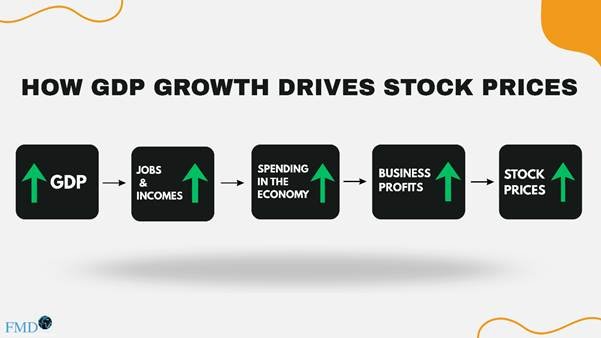
We have to remember the stock market isn’t separate from the economy. The S&P 500 is made up of 500 real businesses, and those businesses are dependent on how much money is flowing through the economy – from consumers, from other companies and from the government. When the economy grows, profits grow and when profits grow, share prices generally follow.
The reverse is just as true. When growth slows, spending dries up, profits shrink, and some companies don’t survive and stock prices fall.
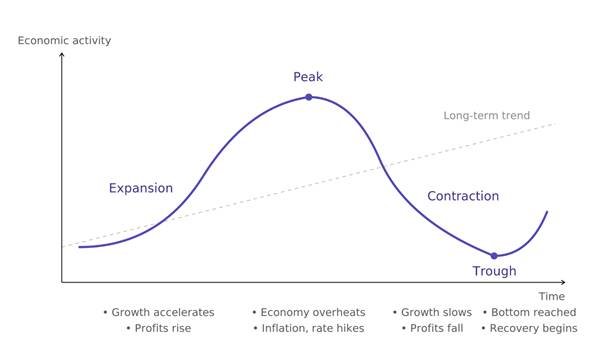
This is why macro investors are obsessed with understanding the business cycle – the rhythm of expansion and contraction that every economy moves through. It has four phases:
- Expansion – economic growth is accelerating, jobs are plentiful, profits are rising, Stocks tend to do well.
- Peak – the economy is running hot, inflation creeps in, central banks start raising rates. The party is still going, but the music is getting louder.
- Contraction (or recession) – growth stalls or reverses, unemployment rises, profits collapse. Stocks usually fall hard.
- Trough and recovery – the worst is behind us, rates get cut, and the cycle begins again.
Each phase rewards different investments and punishes others. The macro investor’s job is to figure out which phase the economy is in and where it’s heading next.
The Business Cycle
Why Interest Rates Move Markets
When an economy runs too hot – usually signalled by rising inflation and surging commodity prices, central banks like the Federal Reserve raise interest rates to cool it down. Higher rates make borrowing more expensive, which slows spending, which slows the economy.
But higher rates also hurt stocks for two reasons:
- Safer alternatives become attractive. When you can earn 5% risk-free in a savings account or government bond, why take the risk of owning stocks? Money flows out of equities (stocks).
- Future profits are worth less today. Companies – especially fast-growing tech and growth stocks are valued based on the profits they’ll make years from now. Higher rates shrink the present value of those future profits, which means lower share prices.
This is why an investor who anticipates rising rates pulls back from risky assets before the rate hike happens, not after. Think back to March 2022, when the Fed kicked off its most aggressive hiking cycle in decades – the S&P 500 went on to fall roughly 25% from its January peak to its October low. Tech and growth stocks fell even harder, with the Nasdaq down around 35%.
So What Is Macro Investing?
Macro investing takes the approach of interpreting the big economic signals – GDP, inflation, interest rates, and employment to form a view on where the economy is heading next, and positioning your money accordingly.
The distinction matters. Most beginners think investing means watching the news and reacting to it: the economy grew last quarter, so buy stocks; inflation came in high, so sell.
By the time a piece of economic data is announced, the market has already absorbed it. The price you see on your screen has already adjusted. Reacting to yesterday’s news won’t give you an edge, because everyone else has seen it too.
Real macro investing asks a different question: where is the economy heading next? Is economic growth about to speed up, or slow down? Is inflation about to ease, or get worse? Will central banks raise interest rates further, or are they done?
This matters because markets are forward-looking. A stock price isn’t a reflection of how a company is doing today, rather it’s a reflection of how investors expect it to do over the months and years ahead. The same goes for the market as a whole. By the time a recession is officially announced, stocks have usually already fallen. By the time the recovery is confirmed, they’ve usually already risen. The market moves on expectations, not announcements.
This is why macro investing answers the most important question any investor faces: where should I put my money?
If economic growth is set to speed up, you want to be in the market, and in the sectors that benefit most from a growing economy. If interest rates are climbing and growth is slowing, you want to be defensive, or out of the stock market entirely. To succeed in macro investing, you have to truly live in the future.
This is the approach hedge funds use to manage billions. The good news is the same logic works whether you’re managing £1,000 or £1 billion. The economic signals are free and publicly available. You just have to learn to interpret them and to position yourself before the rest of the market catches up.
Macro Tailwinds Publication
Interested in this investing approach? I have good news – I’m launching a publication called Macro Tailwinds, where we go deep into the world of Macro Investing. Each month you’ll get macro research breaking down where the economy is heading, what it means for markets, and actionable trade and investment ideas you can put to work.
It’s built for retail investors and complete beginners who want to think like the pros, stay ahead of the curve and make loads of money.
If that sounds like you, follow Macro Tailwinds on Substack – Macro Tailwinds | Adonis | Substack
The first issue will be in your mail box on the 12th of June.
See you there.